
Feature by Willard Manus
We had two big reasons for wanting to visit Mytilini: Theofilos and Molivos.
Theofilos
was, of course, the famed "primitive" painter of Greece and
a native of Mytilini, where, in the early 1900s, he wandered around in
traditional Greek garb, painting on the walls of coffee-houses and tavernas
in exchange for food and drink. An eccentric who rarely washed or changed
his clothes--the locals scornfully called him a paliotsolias, roughly
"a wretched kilt-wearer"--Theofilos spent much of his life in
poverty and humiliation (often being stoned by village brats). It was
only later, in the early 1930's, that he finally found a patron, the Greek-French
collector Efthymiadis Teriade, who paid him a stipend allowing him to
paint anything he liked, any time he liked.
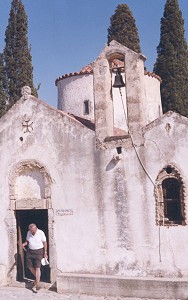
After Theofilos' death in 1934, Teriade joined forces with the poets Elytis
(a Mytilinian) and Embeirikos, plus the painter Tsarouhis and the architect
Yanoulelis, to create the Theofilos Museum, located in the latter's home
village of Vareia. We journeyed there and discovered the site to be a
simple, sun-filled, whitewashed house crammed with the extraordinarily
moving paintings of the artist's final period, notably The Lute Player
of Limnos, which depicts an old musician with his dog. The underlying
feeling of sadness and compassion, the composition and colors, all resonate
in masterful fashion.
The museum holds many other Theofilos canvases that are equally unforgettable, such as Lady With a Dog and The Wrestlers, in which two men grip each other with hieratic, Rousseau-like solemnity while ten impassive villagers look on. More charming and whimsical are the portraits of everyday island life such as Baker's Shop and The Fishermen of Mytilini.
Outside
the museum is an olive grove whose trees come right up to the walls. Mytilini
is famous for its olives; it is said that the island has an olive tree
for every mile between the earth and the sun (93 million). Driving round
Mytilini takes one through endless olive groves, with surprises to come
in the hills where there are forests of pine trees and white villages
sparkling in the pellucid Greek light. Only the southwest side of the
island is barren--it has something to do with the conditions that created
the nearby petrified forest which we unfortunately did not have time to
see, as it required a three-mile hike.
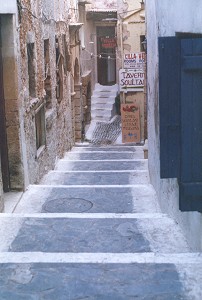
The village of Molivos sits on a headland in the northwest corner of the
island, its houses scattered like confetti under a dominating Genoese
fortress. We had a special interest in Molivos, not only because of its
history and beauty, but because it was a kind of sister village to the
one we called home-- Lindos (on the island of Rhodes). Both had small
artist's colonies existing side by side with the native population. Both
had been discovered in a big way by tourism in the 80s and 90s, thereupon
bringing irrevocable changes to an ancient way of life.
As with Lindos, no cars were permitted to enter Molivos, only motorbikes and three-wheeled mechanized carts. The main artery, 17th of November Street (the date of liberation from 500 years of Turkish rule), was a tunnel of leafy vines and fragrant flowers. Trinket and t-shirt shops line the walkway, but they don't spoil the feeling in the air, which still suggests the poets and writers who once trod these cobblestones--going as far back as Sappho. In more recent times such notables as Theofilos, Elytis, William Golding (Lord of the Flies), Patrick White and Peter Green have made their presence felt here.
The heyday
of Molivos' artist's colony was in the 1970s. "There were only about
a dozen foreigners and 1500 Greeks in Molivos when I first arrived,"
recalled Aviva Layton, a novelist and editor who spent numerous summers
here with her husband, the Canadian poet Irving Layton. "There was
no electricity or running water and the entire island was green and untouched.
No one paid bills until the end of their stay. After four months we were
handed a bill from the grocer. Houses rented for $20 a month."
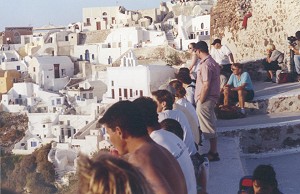
One of the few foreigners who stayed all year round was the Rhodesian-born
novelist and journalist (former architectural writer for the Los Angeles
Times), Leon Whiteson. "There were only five or six of us. Winters
were so windy that often frail little ladies would roll down the hill."
The mood in winter was black, Whiteson said. "The men would sit around and sing depressing Asian-type dirges. We tried to cheer them up one winter by assembling a huge cardboard cake which we wheeled into the kafeneon where the Greeks were playing cards. They barely looked up. Then suddenly with a tearing sound the cake opened up and out stepped a pretty girl in a bikini. No one even smiled, not even a flicker."
Electricity came to Molivos in the mid-70's, followed by Athenian tourists and package groups from northern Europe. This brought prosperity and reversed the depopulation outflow caused by the Junta, poverty and lack of opportunity. Today Molivos is a major Aegean tourist center crammed with bars, discos, fast-food joints, pensions, hotels and studio apartments. One doesn't hear much Greek spoken and the pebbled beach beneath the village is wall-to-wall topless.
Still, one can get a sense of old Molivos by climbing up to the topmost tower of the fortress, facing north to Troy, and gazing out over the very harbor into which Achilles sailed. Homer writes that the Achaeans, between battles during the Trojan War, raided Molivos repeatedly. Indeed, a small village near Petra is still called by its traditional name of Achilliopigadia.
We stayed in Petra that night, in the Pension Achilles; and we dined, of course, in the Theofilos Taverna.